
Losing Mementos
when memory fails not just me

The biggest theme in arguments between me and my mom: who has the better memory.
Sometimes, it’s with mundane things like “how do you not remember where you last put the keys?”
Sometimes, it’s a challenge walk down memory lane: “you don’t remember all the Konglish jokes I told you in the car ride to Big Sur?” (side note: hit me up if you have a good Konglish joke)
Regardless, you can tell it’s an accusation of highest treason to not be able to remember.
Most of us know that the phrase “things end but memories last forever” is not entirely true. There’s trauma that causes memories to be blocked, compartmentalization to keep us agile and nimble with our priorities, and many other mechanisms that our mind employs to keep us moving through life.
But there still seems to be an expectation in society to have a good memory. Memory is needed to do everyday tasks in the workplace, to be a good friend and celebrate everyone’s birthdays, to catch the attention of that special someone with your extra bit of research. Long-term, we put meaning and value into what legacy we’ll leave behind, and legacy is in the form of memories people have of us.
Colloquially, memory indicates that you care, and that you care enough. And even after our time on Earth, we rely on memory to be the truest representation of us.
In 2022, I began to notice my memory abilities quite literally fading. In the middle of a meeting, I’d hold my hand out as if to grab onto a fleeting question I was just about to ask. I was a broken record with the phrases “what was I just about to say?” “never mind, it’s gone” and “was it with you that I talked about _?” In interviews, I’ll hear the question and gear up to tell the answer, but amidst my storytelling… I’ll realize that I don’t even remember what my point was.
Alongside all of this evidence in the physical world underlies the emotional turmoil I’ve willingly pulled myself into. There is guilt in not being careful or caring enough, which snowballs into smart enough, talented enough. There is also shame in not performing as the best friend or loved one that I’ve known myself to be, and I’ve turned to my partner to confide that “I feel like I’m not a good friend at all.”
I feel like the protagonist from Memento, who struggles everyday to piece together his memories. It’s as though my senses have been dulled. And to my validation and surprise, I haven’t been the only one.
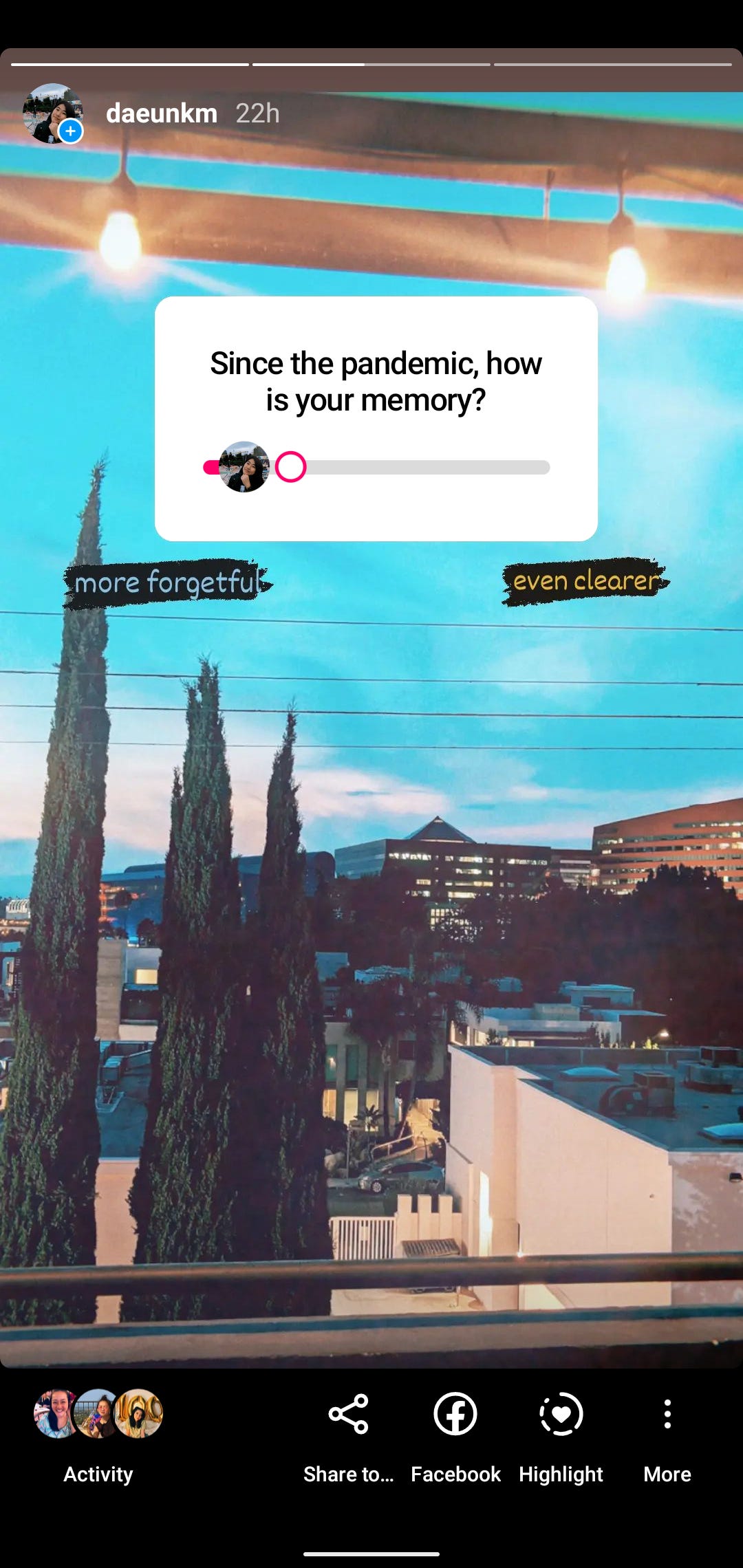
From an IG story I posted on a whim, responses were overwhelmingly on the side of “more forgetful since the pandemic.” And I was able to breathe a sigh of relief when science had my back.
Apparently, pandemic living can make it much more difficult to form a memory at all, let alone call it back when we need it.
It’s an interesting dilemma; at the start of the pandemic, when searching for a silver lining, I appreciated how my life slowed down and I could pay attention to the small moments. But it is almost backfiring on me, as I’ve come to cherish the precious moments… that I am not even forming poignant memories to look back on.
I’ve always been a relatively organized person; I wrote a whole post about my obsession with notebooks. But I’ve gone on to document my life on a whole other level, out of fear that if I don’t have it written down somewhere, my brain is not going to hold onto this memory. I make lists for all the shows I watch, books I read. Small thoughts get dumped into a finsta, and I don’t even care what people would think of my emotional outbursts on there, because what’s worse is not being able to recall any of those parts of my life journey.
So what do we do about it? In a state of monotony, it’s important to find ways to jolt our system into a new context that’s meaningful enough for our brain to store the memories. It could be taking the chance to meet a new person, join a new community, begin a new hobby, anything where you would put in a bit of extra effort to do.
And when we find ourselves being more forgetful, be extra compassionate. We’ve been through a lot in the last 2.5 years, no matter how “normal” aspects of life may feel.
Perhaps, we can also reflect on what would be the most meaningful ways to document our lives, given the range of technologies and options we have and the nature of this phenomenon. We don’t need to just rely on people’s memories to create our legacy; we can reclaim it and mold the documentation to how we’d like. We have some ideas over on bamboo & glass 174. How to Document Memories, Not Just for Instagram (which was recorded without this knowledge about memories, but is an episode I turn to more urgently now).
And I’m gonna find the Korean version of these articles and send it to my mom to end this argument once and for all.